
Alt

SEDarc

SEDarc Postdoctoral Fellowship Competition

The SEDarc Doctoral Training Partnership (DTP) is delighted to announce that we have been awarded funding from the ESRC to host four Postdoctoral Fellows for the 2026-27 academic year. 


Fellowships are aimed at providing a development opportunity for those in the immediate postdoctoral stage of their career, to provide the opportunity to consolidate their PhD through developing publications, their networks, and their research and professional skills.  


Fellowships are for 9 months and are open to any candidate who meets the eligibility criteria. Fellows are encouraged to move departments or institutions and ideally will not take a Fellowship with their PhD supervisors as a mentor. Fellows are expected to be embedded in the DTP: their Fellowship must be situated in one of our five interdisciplinary themes, and they are encouraged to participate in Research in Practice, skills training, and DTP events (e.g. summer conferences). Fellows must have a primary mentor (usually in their home University and associated with the thematic pathway of their research) and will also be given a second mentor from another discipline, SEDarc partner, or sector. We encourage Fellows with a wide range of career aspirations within and beyond the academy and can support the development of external stakeholder networks through our Research in Practice programme. New research cannot be funded through these awards. 


The funding opportunity will be open to applicants who: 

  • Have been awarded a PhD or have passed their viva voce with minor amendments by the application deadline of 1 June 2026 and have been awarded their PhD by the fellowship start date of 1 October 2026.
  •  Have no more than 15 months of active postdoctoral experience, at full-time equivalent and allowing for career breaks. This is measured from the applicant’s viva voce pass date to the application deadline of 1 June 2026.  
  • Are not a permanent member of staff in an academic position with a research component. 

All applicants must submit an expression of interest (EOI) form together with a 2-page CV to SEDarc by 23:59 BST on 16 April 2026. You can obtain a copy of the EOI form and guidance notes here, or please contact your chosen institution in the first instance: 

University of Kent: kentgrc@kent.ac.uk     
Kingston University: hssce-research@kingston.ac.uk    
University of Reading: e.j.bailey@reading.ac.uk   
Royal Holloway, University of London: esrcdtp@royalholloway.ac.uk    
University of Surrey: doctoralcollege@surrey.ac.uk     
University of Sussex: pgr-scholarships@sussex.ac.uk

  
Applications will then be assessed, those shortlisted will then be asked to complete the ESRC application form. SEDarc will peer review the proposals and communicate outcomes by 18 June 2026. Successful applicants will then be asked to upload their applications to ESRC for awarding.  


Further information from the ESRC regarding early career researchers can be found here: Early career researchers – UKRI  
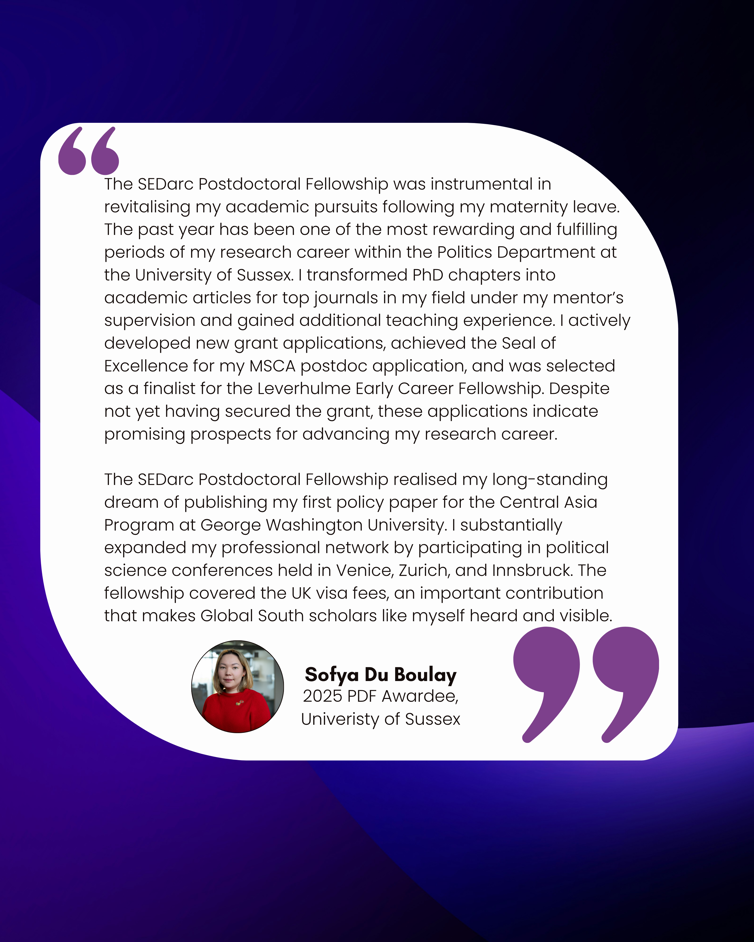


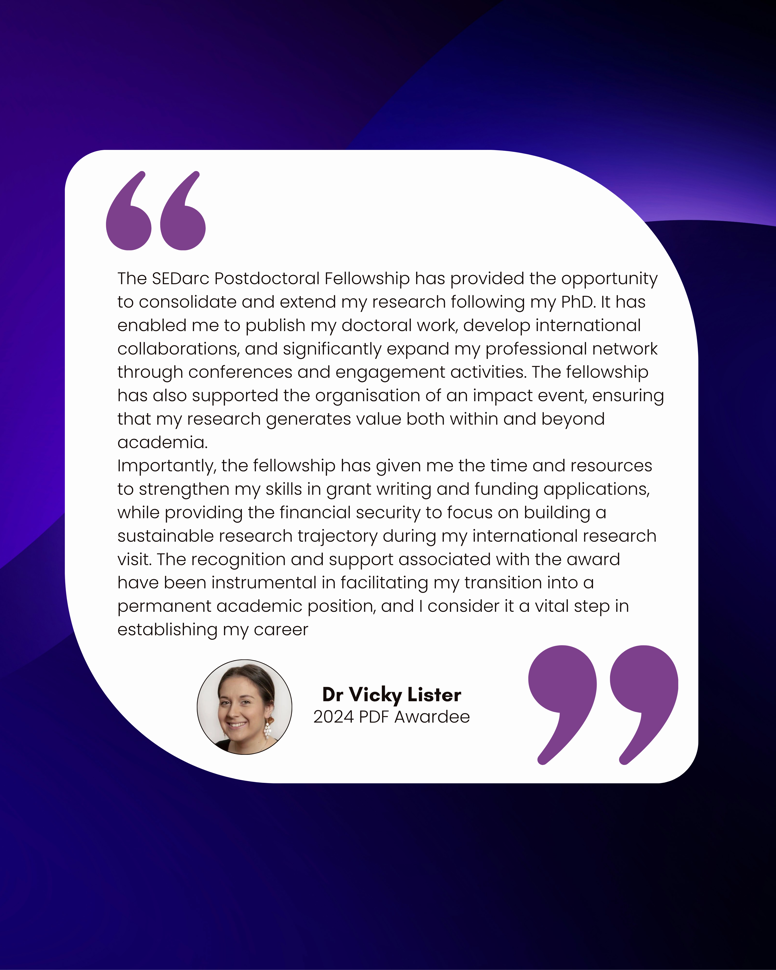
Hear from our 2024 Awardees:

Frequently Asked Questions

What is on offer? 
Successful applicants will receive funding for a Fellowship for up to 9 months full-time or up to 18 months part-time.  
PDF awards include paying the Fellow a salary for the duration of their award and providing up to £7,500 to support their work. 


Which themes or disciplines can I apply for? 
SEDarc has five thematic themes, and each of the themes addresses core social science challenges arising in our region, nationally, and internationally. Postdoctoral Fellows will be asked to select the most appropriate theme, listed below, on their EOI form. Applicants must also fit within one of the eligible disciplines within their chosen SEDarc institution. 


Who can be my mentor? 
Applicants should identify their primary mentor (who would usually be based in the same department), and who ideally is not their PhD supervisor(s). Similarly, candidates will be encouraged to move to a different university and/or department from that of their PhD studies, but we recognise that there may be situations where relocation is problematic due to EDI issues such as caring responsibilities, disability, finance, or other circumstances. 


What is the process?

  1. All applicants must upload an expression of interest (EOI) form together with a 2-page CV to the SEDarc portal by 23:59 BST on 16 April 2026. 
  2. The EOI and CV are then reviewed by the candidate’s chosen institution.
  3. Institutions nominate their highest-ranked candidates to SEDarc, decisions communicated to applicants on 1 May 2026. 
  4. Nominated candidates will be supported by their mentors and institutions to complete the full ESRC application by 1 June 2026. 
  5. Nominated applications are then assessed and ranked by an SEDarc panel. 
  6. Successful applicants (subject to ESRC approval) with be informed on 18 June 2026. 
  7. Candidates then submit their final application by 23 July 2026, online, for awarding. 
  8. Awarded postdocs start on 1 October 2026 and finish on 30 June 2027, unless part-time. 


What should applicants keep in mind when planning activities? 
Applicants should choose activities that clearly support the aims of the fellowship and align with their long‑term career goals. Proposals must outline a realistic and achievable programme of work. Plans that are overly ambitious or include too many activities for the available timeframe are unlikely to be competitive. New research cannot be funded through these awards. 


What kinds of activities are suitable for a fellowship? 

New research cannot be funded through these awards. 

  • Producing publications to help establish a strong research track record is encouraged. 
  • Applicants may engage with a variety of audiences to share and communicate research findings. 
  • Building networks to develop impact opportunities and support future career progression is considered appropriate. 
  • Internships or placements with user organisations are permitted when they form an integral part of the fellowship and support the development of professional and transferable skills. 
  • Further training to enhance research and related skills is suitable within a fellowship programme. 
  • Working on future funding applications is an acceptable activity. 
  • Teaching is allowed if it aligns with the wider aims of the fellowship, up to a maximum of six hours per week. 
  • Visits to leading research organisations, either in the UK or internationally, are eligible when they support collaboration, training, or access to data or resources not available at the host institution.